BJP MLAs led by Manoj Tigger started protesting. The Speaker of the Legislative Assembly was outraged by this incident.
#Kolkata: The Chief Minister is presenting the interim budget before the vote today. Before the budget was presented, there was a great commotion in the assembly. Even inside the assembly, the sound of Joy Sriram was heard.
State Finance Minister Amit Mitra is ill. That is why Chief Minister Mamata Banerjee is presenting the budget today. The Left and the Congress have boycotted the budget. The BJP also raised the question on this day, why the Chief Minister is reading the budget. After this the tumultuous commotion began in the assembly vote.
BJP MLAs started protesting in Well. The BJP MLAs, led by Manoj Tigger, started protesting. The Speaker of the Legislative Assembly was outraged by this incident. The speaker said that if there is such a commotion, strict action will be taken. He also strongly condemned those who went down to the well to protest. BJP MLAs walked out after presenting the budget.
The Chief Minister said in the context of this incident at the beginning of the presentation of the budget, no one behaves like this during the presentation of the budget. But these members of the BJP do not know anything. We say argue, discuss. Instead, 4-5 people create this situation together, then you will understand what the situation is.
By the way, today he is presenting the interim budget of 2021-22. The Chief Minister had earlier said that all decisions would be taken keeping in mind the needs of the poor in this budget. The Congress and the Left have already boycotted this budget.
#Kolkata: Dhundhumar 7 centered on the rejuvenation campaign of the side teachers Subodh Mullick skoyare the protesters scuffle with police. The side teachers also broke the police barricade near Hind Cinema The complaint against the police baton charge by counter-demonstrators.
On this day, the side teachers called for a new campaign to demand stabilization of the salary structure They gathered at Subodh Mallick Square But the police prevented them from proceeding with the procession Protesters accused the side of the teachers, staff carried out unprovoked police on peaceful demonstrations. Several leaders of the organization were also detained RAF, Combat Force 8 reached the spot to handle the situation
In protest, the side teachers sat on the street and started protesting They claimed that their delegation would meet the Chief Minister, as assured by the police. But that promise was not fulfilled, on the contrary, the police beat the teachers Protesting side teachers said they would protest in the streets if not without the detained leaders of the organization. Top police officials came to the spot and tried to convince the protesting teachers
‘The Umbrella Academy’ is making big changes for season 3. The Netflix adaptation of the popular comic book series could be bringing in its own originality, drifting away from the main source. How are they changing some of the main story beats and what should you expect? Keep reading to find out!
A lot had happened by the time season 2 of ‘The Umbrella Academy’ ended. As for season 3 of ‘The Umbrella Academy‘, bigger changes are supposed to be at play. According to where season 2 ended and what could now be the journey for the Hargreeves siblings, it seems like the Netflix series is about to deviate from the comic book series from which it has been adapted. What is the big change everyone is talking about? Find out here!
Highlights —
‘The Umbrella Academy’ had made minor changes before
Season 3 of ‘The Umbrella Academy’ to move away from the main comics
‘The Umbrella Academy’ introduces the Sparrows for season 3
Video Credits: Netflix
‘The Umbrella Academy’ had made minor changes before
When Netflix first brought out the adaptation of the comic book series, ‘The Umbrella Academy’, by Gerard Way and Gabriel Ba, the show seemed to be following in the lines of the major bits of the main source. Sure, there have been a few minor tweaks done here and there for the sake of taking artistic liberty, but Netflix’s ‘The Umbrella Academy’ has always followed in the footprints of its parent book. Season 1 of ‘The Umbrella Academy’ was a clear and true adaptation of the first volume in the comics series, “Apocalypse Suite”. Barring a few ignorable changes, the show kept the major beats except the season finale that presented the Hargreeves siblings failing in stopping the apocalypse, which was not the case in the comic books.
‘The Umbrella Academy’ is making big changes for season 3
Unexpectedly, season 2 of the Netflix adaptation created a bigger gap with comic books. The second volume in the comic book series, “Dallas“, supposedly inspired the second season. According to the comic books, the Hargreeves siblings travel in time back to 1963 to make sure that the assassination of JFK happens (yes, you read that right), which otherwise would alter the timeline bringing upon the world a nuclear apocalypse. Season 2 of the Netflix adaptation made sure that the major storyline is followed in the broader perspective, but there have been a few noticeable changes in the overall story. For example, the members of ‘The Umbrella Academy’ were scattered through various times in the ’60s and the JFK assassination beat was less emphasized. Moreover, the season-ending was far from the ending in the comic books series. The Netflix adaptation had the Hargreeves siblings return to an alternate 2019, where things have changed as an effect of their past actions.
Season 3 of ‘The Umbrella Academy’ to move away from the main comics
The season 2 ending of ‘The Umbrella Academy’ saw some serious deviation from the main comic book’s ending. However, the season finale also hinted at an even bigger deviation from the books for ‘The Umbrella Academy’ Season 3. At the end of season 2, the Hargreeves siblings return to their home to find out that it has been replaced by the “Sparrow Academy” led by Number One who is still breathing in that particular reality. This ending does not come close to what it has set season 3 of ‘The Umbrella Academy’ for, which would probably not be inspired by the third volume in the comic book series, “Hotel Oblivion”.
Shaona and Lovely raised the flag in the presence of Trinamool leaders and actors Bratya Basu and Soham Chakraborty.
#Kolkata: This time Lovely Mitra, the actress of Bangla tele series has joined the Trinamool Congress. He became very popular on television by acting in the serial Jalnupur. On that day he picked up the flag of Trinamool Congress.
Besides, musician and social worker Shaona Khan also joined the Trinamool on this day. She is the daughter of musician Rashid Khan. Shaona and Lovely raised the flag in the presence of Trinamool leaders and actors Bratya Basu and Soham Chakraborty.
On the same day, Bratya Basu said, a lot of young children want to join the grassroots. Especially in the district. Actors and artists of different generations are also raising the grassroots flag. He then spoke about Rihanna and Greta Thunberg, international figures on the peasant movement.
He said some of the central government’s actor celebrities have tweeted against the tweets of Rihanna and Greta Thunberg. But why everyone has the same language in their tweets, this raises the question. In this context, actress Kankana Sensharma raised the question yesterday whether these words are being uttered in any way by intimidating and pressuring the celebrities. Bratya raised the same question.
<!–
Loading…
–>
He said Mamata Banerjee was the only one who had the power to fight against the BJP. That is why Bengali artists are raising the grassroots flag one by one. Apart from Lovely and Shawna, actors Dipankar Dey and Bharat Kal also joined the Trinamool.
Jack Ma, the poster boy of China’s private economy, may have reemerged after three months of hibernation but his Ant Group is still far away from an IPO.
Jack Ma is known for his rags to riches story and his sometimes inspirational and sometimes uncomfortable speeches. He co-founded Alibaba, a half-trillion-dollar online shopping giant. The platform handles more business than any other e-commerce platform in the world. Alibaba created Alipay to handle its own transactions. Today, Alipay is a third-party mobile and online payment platform which handled more than $15 trillion in transactions in 2019. That’s about $9 trillion more than what Mastercard, the leading American multinational financial services was able to do. The reason behind this is that Alipay has been able to tap into the world’s largest market, China.
The Shanghai-based platform has more than 900 million users in China and has revolutionized the way money is exchanged in the world’s second-largest economy. Alipay has successfully turned China into a cashless market. Today, Ant Group has grown beyond Alipay, providing services like microlending, insurance and Tianhong Yu’e Bao, the largest money-market fund in the world.
Not everyone is ecstatic about the success of Ant Group. Banks and regulators in China have recently been critical of the group’s exponential growth and its consequences for the Chinese financial market. Ant has tried to shed this image as disruptor of the Chinese banking system through a series of moves. It rebranded itself as a tech company and changed its name from Ant Financial Services to Ant Group. It also partners with major banks in China to make its money market funds less risky and more reliable. But the Central Bank of China is not convinced.
The Bank is worried about heaps of currency being held by a platform bound by US based tech giant Google, potentially leaving the Chinese financial system vulnerable. In case the investors of Ant withdraw their money out at the same time, it will cause a huge liquidity crisis and potentially destroy the stability of the robust financial system that powers the Chinese economy’s fierce rise. Ant has continued to try and make up to the central bank by capping its investments per person and opening up the platform to rival funds. The company couldn’t buy US money transfer company MoneyGram because of US officials’ national security concerns, causing a big hit to the group’s plan to expand outside China. But this was not the only time that politics has hurt the company.
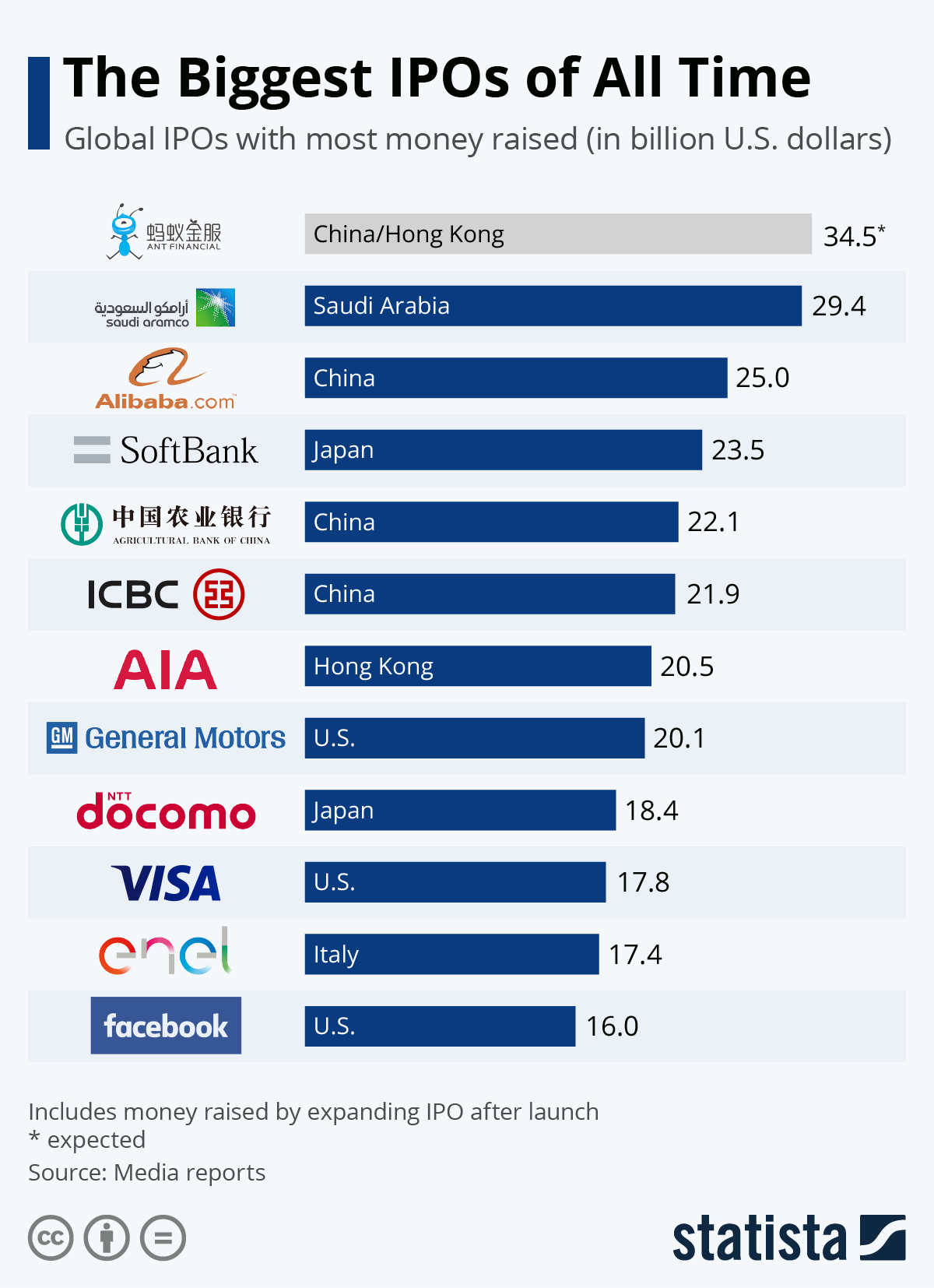
In 2020, Ant Group was gearing up to offer combined IPOs in Shanghai and Hong Kong, valued at more than $20 billion dollars. The listing was going to be one of the biggest listings in history even topping the oil giant Saudi Aramco’s $29 billion IPO in 2019.
But with the grand IPO in touching distance, Jack Ma made public his disdain for the Chinese financial system at an event. He verbalized his discontent, “We shouldn’t use the way we manage a train station to regulate an airport. We cannot regulate the future with yesterday’s means.” Criticizing the regulatory system in China he challenged the state, “Great innovations won’t back down because of regulations. But it shouldn’t be regulated through yesterday’s means.” This provocative speech caused quite a stir within the Chinese government and put wheels in motion, which ultimately put world’s largest listing to a standstill.
People’s Bank of China has proposed stepping up antitrust measures aimed at companies in the non-bank payments industry, which includes Ant Group. Under the proposed rules, the PBOC (People’s Bank of China) can advise the state council’s antitrust committee to stop or even break non-bank institutions, in case their power “severely hinders the healthy development of the payment service market.” China has been clamping down on its fintech sector, which has 233 licensed players at the moment. The central bank fears “the risk of financial contagion resulting from their empire building.” Simply put, PBOC wants to regulate and keep rapidly growing conglomerates in check.
Interesting to see a top regulator—in this FT opinion piece by the deputy governor of the People’s Bank of China—talk in such clear terms about the high risks of fintech. Especially when many banking authorities, like in the US, are going all in on fintech https://t.co/OphdSRsgMEpic.twitter.com/te0GCXisEr
Other than this, the PBOC will keep an eye on the dominant players and come into the picture if their market share reaches a third of the total non-bank payments industry or if the market share of two players combined reaches half of the total. Similar rules will apply to electronic payments, which also includes online and mobile banking payments. Under the new rules, the non-bank payment service providers have to comply with PBOC’s anti-money laundering and anti-terrorism rules. If the company fails to do so, the central bank can revoke its license. As per Liu Xu, a researcher at the National Strategy Institute of Tsinghua University and a long-time advocate for antitrust enforcement, “The rules will set up a framework for future collaboration between financial regulators and law enforcement bodies.”
Ant Concedes to Regulators
All these rules and PBOC’s newfound power directly affect Jack Ma’s future and Ant Group’s IPO hopes. The reason behind the falling off of the IPO is unclear but the heightened scrutiny in light of the proposal was one of the major reasons. The day before the stock market announced that the IPO will not go through, Jack Ma and the top leadership of Ant Group had a meeting with top regulators in the country. This was a clear signal by the regulators and central bank to let Ma and Ant Group leadership know with whom the control of the system lies. Ant was told that it shouldn’t presume to know more about the Chinese financial system than the regulators themselves. The result of the crackdown and subsequent halting of the IPO led to other Ant Group stocks crashing in both Shanghai and Hong Kong stock markets.
Watch: How Ant’s IPO Unraveled
Video Credits: WSJ
Continuing the crackdown on Ma, China’s State Administration for Market Regulation (SAMR) announced an investigation into Alibaba. This heavily affected the morale of investors and customers alike. Ant released a written apology to the regulators and stated that they would ‘embrace regulation’.
The embrace cost Jack Ma his voice. The ever so outspoken businessman maintained his silence on social media, staying out of public life since October 2020, only to reappear on January 20, 2021. Nevertheless, Ma’s low profile has put investors in doubt. His single appearance added $58 billion in market value on Alibaba’s Hong Kong-listed shares. But the bullishness was unable to hold for a long time as it fell 3% two days later.
Ma is an extremely important figure for the company. “One of our top criteria is leadership and we were investing in Alibaba because I really respect Jack Ma as a leader,” said William Huston, founder and director of institutional services at independent investment advisory firm, Bay Street Capital Holdings in Palo Alto, CA, with Ant assets under management of $86 million. So, as long as it seems that Ma is on the radar of the Chinese government, Ant Group and its affiliates will continue to suffer.
The People’s Bank of China Governor gave hints that Ant Group’s IPO could be back on track if it followed legal procedure. Alibaba’s stock may react positively if the Ant IPO goes through. #antgroup#alibabapic.twitter.com/haqsPpexS2
The Central Bank has said that Ant Group can again offer an IPO if the issues are resolved with respect to the regulations. But the fate of Ant’s IPO remains as cloudy as Ma’s public presence for the time being.
Dipankar Dey today admitted that he joined the grassroots out of personal gratitude to Mamata Banerjee. “I have been in favor of the grassroots for a long time,” he said But I can go everywhere for so long due to physical reasons But to the grassroots, I have gratitude and responsibility to Chief Minister Mamata Banerjee. He has honored me with Banga Bhushan, Banga Vibhushan It’s the biggest thing in my life